











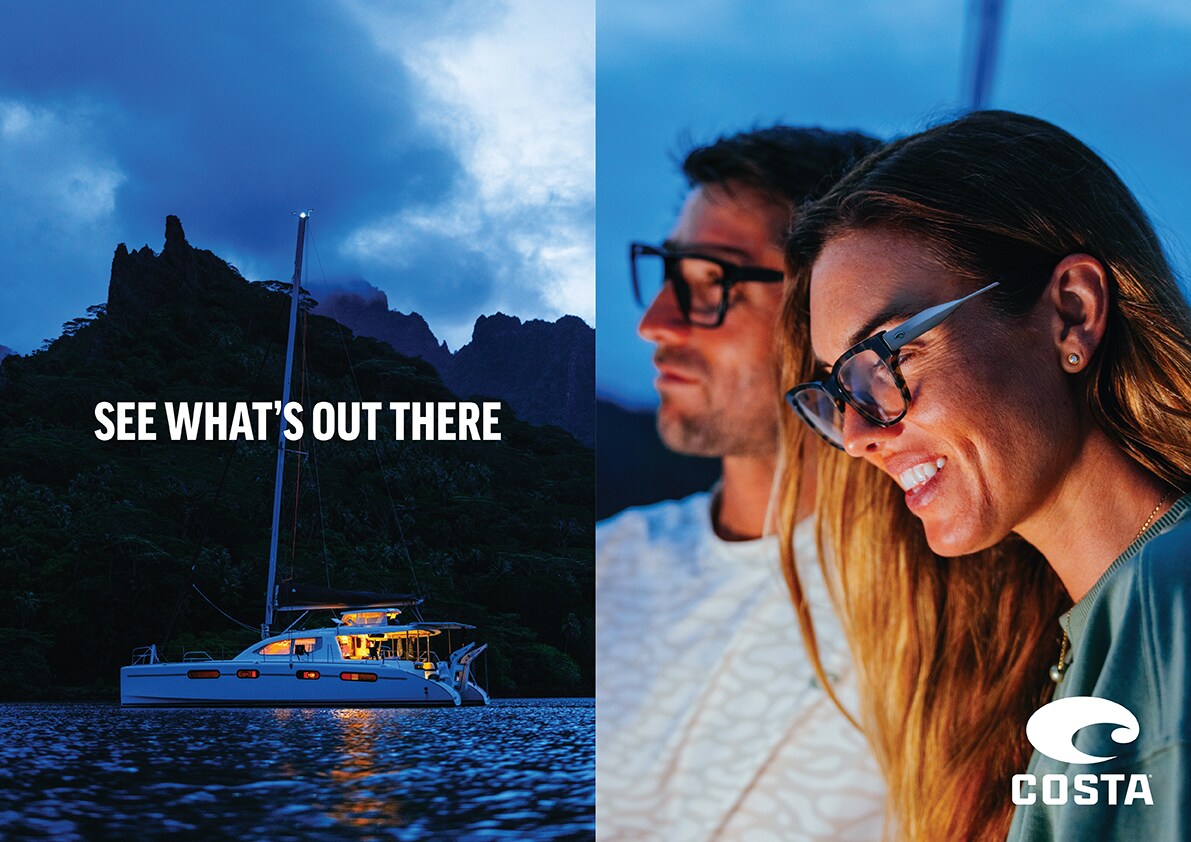
Costa Del Mar: the sunglass for people who live off the sea
Some brands invent a maritime backstory to sell. Costa Del Mar did the opposite: it was invented by a group of Florida fishermen who in 1983 got tired of their sunglasses falling apart after one day on deck. Forty years later, you still feel that difference the moment you put them on aboard a sailboat, an offshore charter or a board off Pozo Izquierdo. This is about that.

Born on the water
Costa starts in Daytona Beach, Florida, 1983. Founder Ray Ferguson had spent half his life fishing offshore and half his life dumping half-melted sunglasses into the locker. So he made his own: properly polarised tempered glass, frames that didn't rust in salt air, hinges that stayed tight and temples that gripped when sweat started running. The phrase they launched with is the same one that still owns the brand today: Born on the water.
In 1986 the Stars & Stripes crew wore Costa when they won the America's Cup. That's the moment the brand stopped being a fisherman's secret and started showing up on regatta decks, charter boats and fishing guides across the southern US. Essilor bought Costa in 2014, in 2018 the company became part of EssilorLuxottica and production moved to Foothill Ranch, California. The owners changed; the character didn't. The DNA is still a fisherman designing for other fishermen.
580 lens technology: the only thing that matters
If there's one reason to spend what a Costa costs, it's the 580 lens. The "580" is the wavelength in nanometres that the lens fully blocks. That yellow band is the one that saturates your eye on water and flattens colour. Cut it out and reds, greens and blues jump with almost surgical contrast. In practice that means you actually see where the fish is under the surface, you see the drop-off, you see the difference between sand and seagrass from 20 metres away. No fashion finish competes with that.
Polarisation sits at 99.9% — the highest level claimed in the industry. They also block High-Energy Visible (HEV) blue light, the one that gives you eye fatigue after six hours of reflected glare on water.
580G (glass): the optical option
Tempered glass. The clarity is the best you'll see in a sunglass, period. Costa makes it 20% thinner and 22% lighter than a standard polarised glass, and they encapsulate the mirror coating between two glass layers, so the outer surface can't scratch — which is what kills any cheap mirror lens. This is the lens for long hours on the water: regatta sailors, offshore skippers, fishermen who actually need to see. A bit heavier than poly, but we're talking grams.
580P (polycarbonate): the resistant option
Lighter, more impact-resistant, almost indestructible. Slight loss of crispness vs glass, imperceptible in real use. This is the lens for surf, kitesurf, kayak, anyone who loses sunglasses regularly and anyone who's going to drop them on a deck. By the way, the P in 580P does not stand for "polarised" — it stands for polycarbonate. Every Costa is polarised, P or G.
Which mirror, if you live in the Canaries
Blue Mirror — grey base, 10% transmission. The offshore fisherman's lens. If you're chasing tuna from Mogán, Pasito Blanco or Las Galletas, this is the one. Kills surface glare at full sun better than anything else.
Green Mirror — copper base, 10% transmission. For spinning from shore, sight-fishing in shallows, casting lures off the piers. The copper base improves contrast over green and rocky bottoms.
Copper Silver Mirror / Copper — variable light, fly fishing, rivers and rock-edge. Anyone fishing sea bass from the cliffs in La Palma or northern Tenerife usually settles on copper.
Silver Mirror / Gray — general use. Day-to-day on the water and off it. If you're only going to own one pair, go grey.
Sunrise Silver Mirror — amber base, 30% transmission. Sunrises, overcast days, early kitesurf sessions at Pozo Izquierdo when the sun is still grazing the water. This is the lens that performs best in low light.

The detail you only get once you get wet: Hydrolite
The temples and nose pads on Costa frames are made with a proprietary rubber called Hydrolite. The trick is that the wetter it gets, the better it grips. Sounds like marketing — it isn't. That's exactly what keeps these glasses from sliding down your face after two hours of sweat on deck and six face-fulls of seawater. Anyone who's tried to fish, surf or sail in a pair of Ray-Bans knows what I mean. It's the difference between a sea-grade sunglass and a sea-themed one.
Hinges are stainless steel. Recent frames are built in Bio-Resin (a nylon partly derived from castor bean oil — Costa has converted 100% of its nylon frames to this material) and the PRO models add side sweat drains, removable side shields and ventilated, adjustable nose pads.
What we carry at Gafas Canarias
We picked the models that make the most sense for how the sea is actually used here. Here's what we have in stock right now:
Fantail — the bestseller
Compact wraparound, mid-profile, 59 mm. Costa's all-time bestseller for a reason: fits almost any face, polarises brilliantly, lasts. We carry three finishes of the Fantail 9006 from €132. If you've never owned a pair of Costa, this is the entry point.
King Tide 6 and King Tide 8 — the technical flagship
Launched with the 40th anniversary, this is everything Costa has learned in one frame: shark-gill venting, removable side shields, integrated sweat channels, premium Hydrolite. The King Tide 6 (base 6, mid-profile) and King Tide 8 (base 8, max wrap) sit at €247-262. The do-it-all glass for people who spend the day on the water.
Blackfin Pro and Reefton Pro — the big technical wraps
The Blackfin Pro is Costa's classic large wrap, 60 mm front, full side-light cover. The Reefton Pro is even bigger, 8-base wrap, built for hard tropical sun. Both €212.50. Offshore fishing or sailing regattas, these two.
Whitetip Pro — the mid wrap, fully kitted out
The Whitetip Pro (€202) is the middle option — ventilation and shields without the Blackfin/Reefton volume. Good if the big PRO frames feel too much on you.
Lido and Taxman — modern day-to-water silhouette
The Lido (€196.50-212.50) and Taxman (€189.57-191.50) are the more urban shapes with 580 tech inside. The pair you can walk into dinner with after a day on a boat.
Finlet, Fly Line, Grand Catalina, Santiago, Rincon II — the rest of the catalogue
Lighter, more urban or more specific. Finlet (€130-170) is the most affordable entry. Fly Line (€138) is the textbook fly-fishing pair. Grand Catalina (€184-188) has a heritage feel. Santiago (€170.50) and Rincon II (€139.50) are wayfarer-classic shapes with 580 glass inside.
Ferg XL — the founder tribute
The Ferg XL (€182.47) is the homage to Ray Ferguson. Classic XL silhouette with everything Costa knows packed in. For larger fits.
Shipmaster — the veteran
The Shipmaster (€182) is the classic offshore skipper's frame. Metal wraparound, captain-of-the-deep energy.
SEE THE FULL COSTA COLLECTION →
Ocean commitment that isn't marketing
This is the part that resonates most in the islands. If you live off the sea, you take care of it. Costa has been doing that tangibly for 40 years:
Kick Plastic, running since 2015, estimates it prevents 500,000 single-use plastic bottles a year through its network of partner fishing guides. Untangled Collection is the Antille, Pargo, Santiago and Caleta line, with frames built from 97-100% recycled fishing nets in partnership with Bureo (a Chilean group that collects abandoned nets from harbours, pellets them and re-injects them as raw material for the frames). Bio-Resin is the castor-oil nylon that has replaced 100% of petrochemical nylon in Costa frames. OneCoast supports coastal communities after natural disasters. Save the Reef participates in ghost-net recovery and coral restoration.

How to choose, in one line
Offshore or a lot of boat time, Blackfin Pro or Reefton Pro in 580G Blue Mirror. Spinning from shore or sight-fishing, Fantail or King Tide 6 in 580G Green Mirror. Kitesurf, surf or any impact-prone sport, any 580P in grey or Sunrise Silver. Day-to-night frame that handles deck-to-dinner, Lido, Taxman, Santiago or Grand Catalina. One pair to rule them all, grey 580G.
Come by the shop and try them on. Costa really needs to be tried on face — the wrap, the front, where they sit, all changes a lot between models. And the difference between a pair that survives a full day on the sea and a pair that ends up in a drawer is almost always decided in the first minute on your face.
SHOP COSTA AT GAFAS CANARIAS →
Costa Del Mar is a registered trademark of Costa Del Mar, Inc. (EssilorLuxottica). 2026 campaign imagery.
Read more
Week 15 · 2026 New this week. A week with Ray-Ban taking center stage, Ralph Lauren and Polo delivering timeless prescription frames, Ver Sport bringing sport eyewear and Nanovista for the litt...
Why Maui Jim works so well in the Canaries: PolarizedPlus2 with rare-earth mineral injection, lens materials (SuperThin Glass, MauiPure, MauiBrilliant, MauiEvolution), signature tints (HCL Bronze, ...