













Best sunglasses for Tenerife and the Canary Islands 2026: UV, salt, wind
Updated · May 2026 · By the Gafas Canarias team
What makes good sunglasses for Tenerife (and the rest of the Canaries)?
Three things, in order: UV400 protection (Canary UV index hits 9-11 in summer, extreme by WHO standards), polarization (Atlantic reflections, black-sand glare and white-promenade light are punishing), and a frame that survives salt, calima and wind (stainless steel, titanium, marine-grade acetate, polyamide composite). The brands engineered for these conditions: Maui Jim and Costa Del Mar for the sea, Ray-Ban G-15 mineral for the coast, Oakley Prizm for hiking volcanic terrain, Persol mineral for driving. Below: 12 picks by lifestyle, plus how to care for them properly. Sunglasses for the Canaries →.
What you'll learn
- Why Tenerife is uniquely hard on sunglasses (UV index 9-11, calima, trade winds)
- What to look for in the lens: UV400, polarization, category 3 sweet spot
- Frame materials that actually survive salt (acetate, titanium, polyamide)
- Our 12 picks by lifestyle: beach, driving, hiking, urban, sport
- A care routine that makes them last 10 years instead of 1
- Brand comparison: Maui Jim, Costa, Ray-Ban, Oakley, Persol, Bollé
Why Tenerife is uniquely hard on sunglasses
The Canary Islands sit at ~28°N latitude — closer to the tropics than to most of Europe. Thin atmosphere, lots of sun hours, no continental haze. The result: UV index reaches 9-11 in summer, classified by the WHO as extreme. For comparison, mainland Spain peaks at 7-8 in summer; UK and northern Europe at 5-7.
Add three more local factors that mainland Europe doesn't have:
Salt-spray: every coastal town gets daily salt aerosol. Salt is the enemy of cheap metal hinges and uncoated screws.
Calima: Saharan dust events several times a year. Fine, abrasive particles. Scratches lenses if you wipe them dry.
Trade winds: persistent, often 20-40 km/h. Wind dries the eyes and pushes dust into them — sunglasses become eye protection, not just fashion.
Choose the right lens and the right frame, and your sunglasses will outlive your phone. Choose wrong, and you'll be replacing them every season.
What to look for in the lens
UV400 — non-negotiable
UV400 means the lens blocks 100% of UV up to 400 nanometres (covers UVA and UVB). It's printed on the lens or temple of every reputable brand. If a pair doesn't claim UV400 explicitly, assume it doesn't have it.
Polarization — the right call for 95% of uses
Polarized lenses eliminate horizontal glare from water, asphalt, white sand, glass. In the Canaries this matters because:
Atlantic light off the water is intense from any beach or boat.
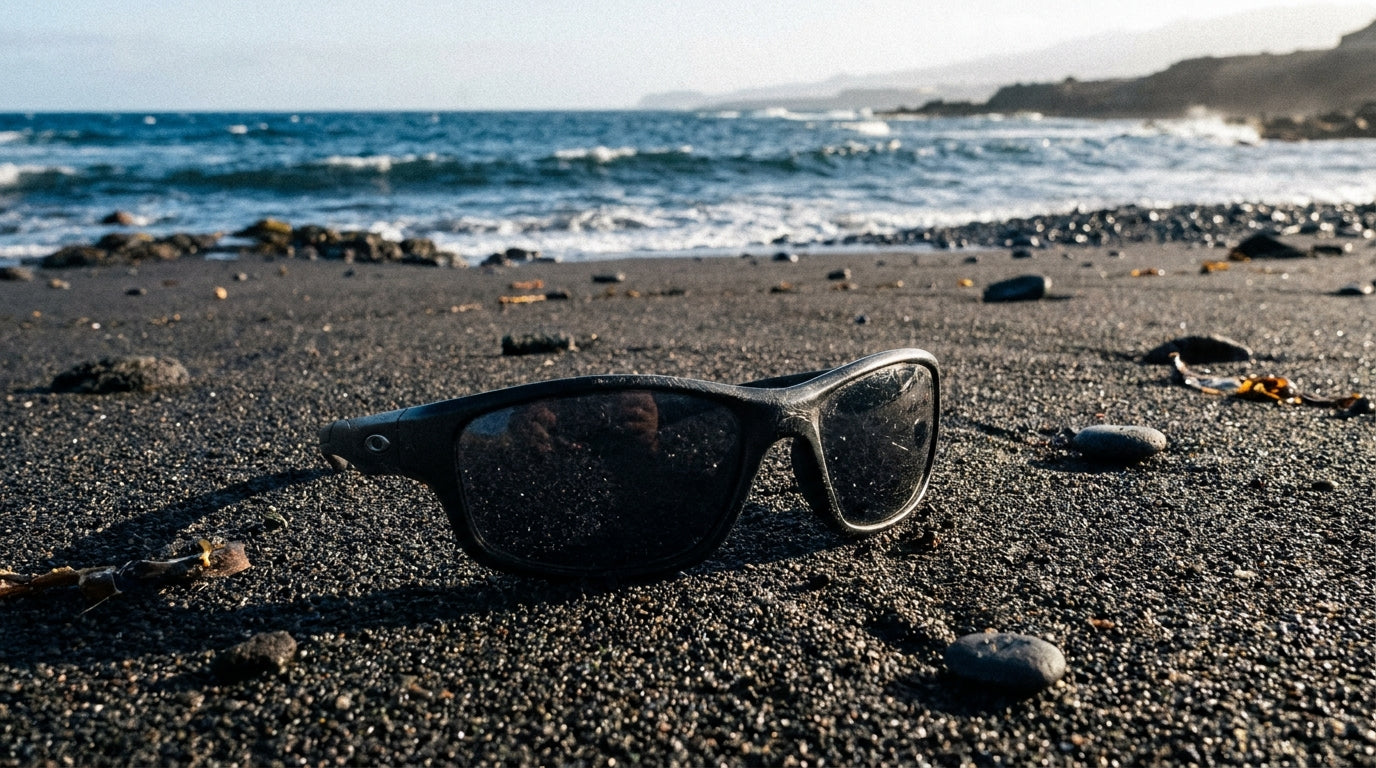
Black volcanic sand creates flat reflections that bother your eyes more than light sand does.
Tourist promenades (Costa Adeje, Las Américas, Maspalomas) are white-tiled and act like mirrors at midday.
Asphalt of coastal roads (TF-1, GC-1) reflects strongly when wet from rain or salt spray.
Category 3 — the sweet spot
Lens categories run from 1 (very light tint) to 4 (very dark, for glacier). For the Canaries, category 3 is the right choice for daily and beach. Category 4 is too dark for driving and is technically illegal at the wheel in Spain.
Tint colour — grey vs brown vs green
Grey = neutral colour rendition, best for driving. Brown/amber = enhanced contrast, great for hiking and golf. Green (Ray-Ban G-15) = balanced contrast and true colours, the all-rounder. Avoid yellow/orange tints in this latitude — they look cool but reduce visual comfort.
Materials that survive salt and sun
Top-grade Italian acetate (Ray-Ban, Persol, Tom Ford, Oliver Peoples): comfortable, lightweight, doesn't corrode. Perfect for daily, ages beautifully.
Stainless steel and titanium (Lindberg, Silhouette, premium Ray-Ban metals): salt-resistant, very durable. Titanium is essentially lifetime-proof.
Polyamide / composite (Oakley, Bollé, Maui Jim sport): made for sport, flexible, very impact-resistant, won't snap.
Nylon-based composites (Costa Del Mar): salt-spray engineered. Their pads and hinges are designed for marine environments.
Avoid: cheap nickel-plated metal (will pit and rust within a season), low-grade acrylic (yellows with UV), beach-stand plastic (will warp at 50ºC in a closed car).
Our 2026 picks by lifestyle
For the beach and the sea
Maui Jim Red Sands PolarizedPlus2: the gold standard for sea use. Lightweight, perfect polarization.
Costa Del Mar Reefton 580G: glass polarized lens engineered for fishing. Sees through water.
Oakley Sutro Lite Polarized: light, sporty, polarized — perfect for paddleboarding and beach walks.
Bollé Lightshifter Photochromic: adjusts to changing light. Useful at sunset.
For driving the coast (TF-1, GC-1, TF-5)
Ray-Ban Aviator Classic G-15 Polarized: the ultimate driving sunglasses. Mineral lens lasts decades.
Persol 649 Polarized: Italian mineral lens, perfect for coastal driving. The classic.
Oakley Holbrook Prizm Driving: enhances contrast on bright asphalt and detects road hazards faster.
Maui Jim Castles: aviator-shaped, polarized, very comfortable for long drives.
For hiking volcanic terrain (Teide, Anaga, Pajonales)
Oakley Sutro Prizm Trail: enhances dirt-road and lava contrast. Wraparound for wind.
Bollé Tigersnake Photochromic: changes tint with light. Perfect for hikes with changing exposure.
Ray-Ban Stories Headliner: classic shape, lightweight, fits trail comfortably.
Persol 714 (folding): stows in a small pocket between climbs. The travel classic.

How to make them last a decade
The single biggest factor in sunglasses lifespan in the Canaries is what you do after exposure. Do this and you'll keep them in shape:
After every beach day: rinse with fresh water (under the tap is fine). Salt left on the lens scratches when you wipe.
Clean only with microfibre, never paper or t-shirt. Cotton fibres scratch coatings.
Hard case in the car, always. A closed car dashboard hits 50-65ºC in summer. Coatings degrade at those temps. Keep them in the glovebox case.
Tighten loose screws yearly. Free at any optician (we do it at no cost in Gafas Canarias for any pair).
Replace pads every 2 years. Sweat and sunscreen degrade the silicone. New pads cost €5 and bring the gafa back to life.
Calima days: don't dry-wipe the lenses. Rinse first, then microfibre.
Done right, a €200 Ray-Ban Aviator will last 10 years easy. Done wrong, even a €600 Persol won't see year 3.
Sunglasses built for the Canary Islands
The bottom line
Tenerife needs UV400 + polarization + a salt-resistant frame — period. For sea pick Maui Jim or Costa. For driving the coast, Ray-Ban G-15 mineral or Persol 649. For trails, Oakley Prizm. Rinse with fresh water and store in a hard case, and they last a decade.
What people ask us most
What UV protection do I really need in Tenerife?
UV400 minimum. The Canary Islands sit at low latitude with thin atmosphere — UV index regularly hits 9-11 in summer (extreme by WHO standards). Even cloudy days reach 5-6. UV400 blocks 100% of UVA/UVB up to 400 nm and should be on every pair you buy.
Should sunglasses for Tenerife always be polarized?
For 95% of uses, yes. The Atlantic reflects intensely off water, black volcanic sand reflects oddly, and white tourist promenades create flat glare. Polarized cuts all of that. Only skip polarization if you sail and need to see surface ripples, or if you have to read LCD instruments (some pilots, some boat displays).
Why do cheap sunglasses fail in the Canary Islands?
Three reasons. UV protection is often fake (no real UV400 layer). Frames degrade fast in salty air (cheap nickel-plated metal corrodes). Lenses yellow within a season because the plastic isn't UV-stabilized. The result: you pay 25 € twice in a year instead of 150 € once for ten years.
What about calima (Saharan dust)?
Calima blows fine Saharan dust over the islands several times a year. Dust particles scratch lenses if you wipe them dry. Always rinse with fresh water first, then dry with microfibre. Avoid sleeping with them on the dashboard during a calima day.
Best brands for Tenerife conditions?
Maui Jim and Costa Del Mar specifically engineer for tropical/marine environments. Ray-Ban G-15 mineral lens handles UV brilliantly. Oakley Prizm enhances volcanic-rock contrast. Persol mineral is perfect for coastal driving. Bollé is great for sport. Avoid no-name beach-stand stuff.
Can I get prescription sunglasses delivered to Tenerife or Gran Canaria?
Yes. Order online, send your prescription, we fit polarized prescription lenses in our Tenerife workshop and ship in 5-7 working days to any Canary address. Free shipping over €60.
Do sunglasses get damaged by salt water?
Yes, over months. Salt corrodes uncoated metal, salt crystallizes inside hinges, and salt residue scratches lenses if you wipe them dry. After every beach day: rinse with fresh water, dry with microfibre, store in a hard case.
What lens colour is best for the Canaries?
Grey for true colour rendition (best for driving). Brown or green for contrast (best for outdoor sport, hiking, fishing). Mirrored silver/gold for very bright midday light (sport). Avoid: yellow/orange tints — they look cool but offer no benefit in this latitude.
Read more
Everything about ordering glasses online and shipping to the Canary Islands in 2026: IGIC pre-applied at checkout, delivery times by island, where lenses are fitted, 30-day returns and 2-year warra...
Everything about ordering glasses online and shipping to the Canary Islands in 2026: IGIC pre-applied at checkout, delivery times by island, where lenses are fitted, 30-day returns and 2-year warra...